13-Day Morocco Tour from Tangier with Sahara Camp and Imperial Cities


About This Tour
Embark on a captivating journey through Morocco's diverse landscapes, from vibrant Tangier and picturesque Chefchaouen to the imperial grandeur of Fes. Venture...
Duration: 13 Days · Tour type: Private · Activity level: Easy · Accommodation: Included · Standard · Transport: Included · Wheelchair access: Yes · Cities: Casablanca, El Jadida, Fez, Marrakech, Essaouira, Midelt, Ouarzazate, Tinghir, Tangier, Toubkal, Chefchaouen, Merzouga, Todgha Gorge, Erfoud, Rissani, Aït Benhaddou, Erg Chebbi, Ifrane, Boumalne Dades · Languages: Arabic, English, French, Spanish
Know before you go: Some home-cooked dishes with local families are available upon request and will be at the customer's expense.
About El Jadida

El Jadida
Explore the list of top ranked local tour guides in El Jadida. Get tour activities offered by tour companies and independent travel guides in El Jadida.
What's Included
- English-, French-, or Spanish-speaking professional driver/tour guide
- Shuttle from and to the airport
- Accommodation is organised at all stages of the tour
- Air-conditioned vehicle
- Visit to women's cooperatives
- Toll road fees, fuel charges, and all taxes
- Transport insurance
- An opportunity to give back and meet up with locals
- Camel ride in the desert
- Daily breakfast
Not Included
- Flights
- Travel insurance
- Gratuities
- Entrance fees to historical monuments
- Additional services
- Drinks
- Anything not mentioned in 'included'
Itinerary
-
1Day 01
Arrival in Tangier, Gateway to Africa
Today is the day you cross from Europe to Africa by ferry. Once you reach the other continent, your driver/tour guide will welcome you to Tangier, the gateway between Europe and Africa. Lying on the Maghreb coast at the western entrance to the Strait of Gibraltar, Tangier offers a unique blend of cultures and influences that have shaped the city for centuries, attracting artists, spies, and eccentric foreigners. While the port city was once dismissed as a not-so-hot place to visit, Tangier today has undergone a makeover and gleams with pride.
-
2Day 02
Tangier City Tour and Coastal Landmarks
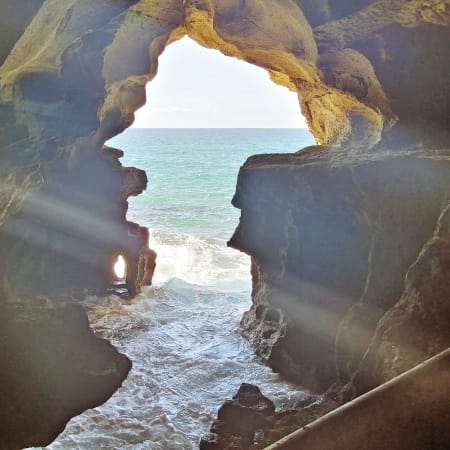
We start this tour from Tangier, the gateway from Europe to Africa. It is named for the goddess Tinge, the lover of Hercules, who legendarily pulled Europe apart from Africa to form the Strait of Gibraltar. A dramatic drive takes you through La Montagne over a pine-covered headland to the Cap Spartel Lighthouse, just 14 km west of Tangier. 5 km further, you'll reach the Grottes d'Hercule, where you'll enjoy a much-photographed view from within the mythical dwelling cave of Hercules that resembles a map of Africa. Back in the medina, you'll spend a few hours meandering down the alleyways within its 15th-century Portuguese fortress walls to visit the Kasbah Museum of Mediterranean Culture. Wander up to St Andrew's Church for a spot of gravestone reading, then take in the latest art exhibition at Centre Culturel Ibn Khaldoun.
-
3Day 03
From Tangier to the Blue City of Chefchaouen
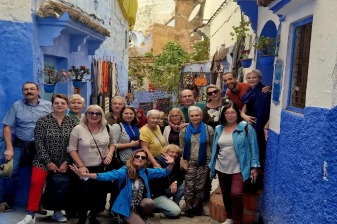
Leaving the famously decadent Tangier, with its Europe-facing medina, head to the blue-hued city of Chefchaouen in the Rif Mountains and enjoy the scenic route. Chefchaouen offers endless winding, narrow streets and picturesque buildings. Find Plaza Outa el Hammam for a restaurant or café and enjoy a meal while people-watching. Though non-Muslims are not permitted to enter, the Grand Mosque is still worth a visit. From there, explore the nearby kasbah and tour the garden, museum, and some of the old prison cells. Follow a path outside the city walls to Hotel Atlas and climb to the rooftop to enjoy a panoramic view of the Blue City. For the slightly more athletic, follow the street east, pass over the Ras el Ma Spring, and ascend the path for 20-30 minutes until you reach the abandoned white Spanish Mosque. Enjoy one last view over Chefchaouen as the sun sets behind the mountains.
-
4Day 04
Chefchaouen to Fes via Scenic Stops
Rise early to snap photos of the people-less streets before leaving for Fes. Stop along the way at the dam to enjoy fresh juice. Continue to Fes, with its impressively large and somewhat confusing old medina; Fes is a city worth getting lost in. Before venturing into the medina, visit the Pottery Cooperative, located just south of the city, and enjoy the all-handmade crafts of historic Fes and the surrounding area. Descend the hill and return to your riad, a traditional Moroccan house with an interior garden, for the evening.
-
5Day 05
Guided Walk Through the Medina of Fes
Fes is the oldest of the imperial cities in Morocco - Meknes, Marrakech, and Rabat are the others - and perhaps the most interesting to explore. A UNESCO-protected site, the city hasn't undergone much colonial development, leaving you to experience its medieval charm. Fes consists of two old medina quarters, Fes el Bali, where you will spend most of your time, Fes el Jdid, a slightly newer part of the city, and the early 20th-century French-designed Ville Nouvelle. Meet your guide to help you navigate the narrow and maze-like ancient streets of the medinas, starting in Fes el Bali (789 CE). Spanish- and Tunisian-influenced architecture is evident in various souks offering spices, leather goods, and pewter. Known for its tanneries and the acrid smell associated with them, visit the popular Chouara Tannery and climb to the roof of a nearby shop for a better view of the goings-on. Visit the 14th-century Al Attarine Madrasa and admire the zellij tilework before checking out one of the world's oldest still-operating universities, Al-Qarawiyyin University (859 CE). Find the mellah, the old Jewish quarter, in Fes el Jdid for another encompassing view of the city.
-
6Day 06
Across the Middle Atlas to Merzouga
Continue your journey south, over the Col du Zad pass (7,146 feet or 2,178 m) and through the cedar forests of the Middle Atlas Mountains. You will see families of Barbary macaque monkeys in the trees and by the side of the road as you head to Midelt, the "apple city," for lunch. Appreciate the scenery of the Moulouya River and the apple orchards. Next, travel over the Tizi n'Talremt pass and into the Ziz Valley, dotted with oases and clusters of palm trees. Notice the many ksars and fortified houses merchants built to protect their wares, including gold, salt, and spices. Nearing Erfoud, you will start to see the early signs of the Sahara dunes. Never stationary, the dunes travel as the winds shift. If you're lucky, you may come across a nomadic Berber family and have the chance to drink tea together. Visit Erfoud and discover how the fossil-rich rock from its mines is transformed into decorative and practical objects. Continue to the extensive sea of dunes of Erg Chebbi. Covering 13.5 square miles (35 square km), some dunes rise to over 656.2 feet (200 m), their colour changing with the moving sun.
-
7Day 07
Merzouga Desert and Sahara Camp Experience
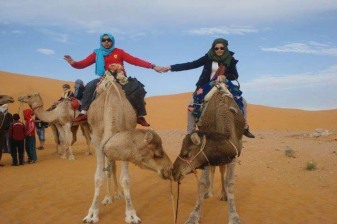
Wake early to catch a desert sunrise before trying your skill at climbing dunes. You can also exercise with yoga. Afterward, enjoy a Berber traditional pizza, or "Madfouna," for lunch. This is more of a stuffed flatbread similar to a calzone or stromboli. The dough is filled with beef or lamb, diced onions, and various spices, then baked in a fire pit until done, while many restaurants and local Berbers cook it in a mud oven. Visit nearby Khemliya, a typical Saharan village whose people are originally from Mali, and enjoy traditional drumming music and dancing before walking around the settlement. You can take a short break near Merzouga and store any baggage while packing an overnight bag to bring along. You'll then have the chance to be accompanied by a camel and a blue-turban-robed guide into the sandy seas. After an hour-long camel ride, you will be among the lucky few to watch the sunset over the Sahara dunes and stay in a Bedouin-style tent.
-
8Day 08
From Merzouga to Todra Gorge and Dades Valley
Leave the dunes behind and head to Rissani, entering through its impressive gate. Known for its livestock auction, finding the "donkey parking lot" is worth your time and is sure to delight your senses. Continue to Tinerhir. This desert town offers incredible views of neighbouring towns hugging the length of the extensive river oasis, with 30 miles (48 km) of palm trees. Stop at today's final destination, the Todra Gorge. Rising 984 feet (300 m) high and carved by the Todra River through red limestone, it is a wonderful place to enjoy a leisurely walk in and around the gorge and relax in the cool waters of the shallow river below. After visiting the women's cooperative of rugs and carpets, head straight to Dades Gorges to spend the night there before driving to Marrakech. Settle into your accommodation in the gorge before wandering among the nearby small family farms and the valley in the late afternoon. Long after the day crowds have left, enjoy a quiet dinner overlooking the valley.
-
9Day 09
Aït Benhaddou, Ouarzazate, and the High Atlas
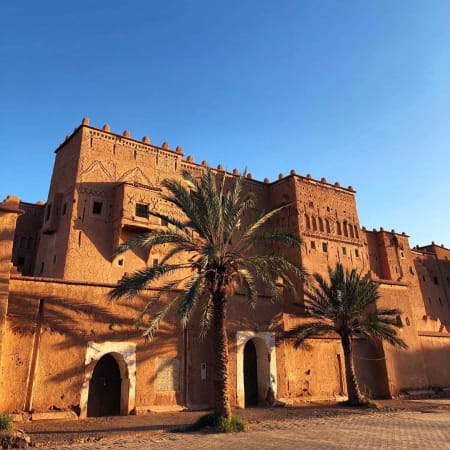
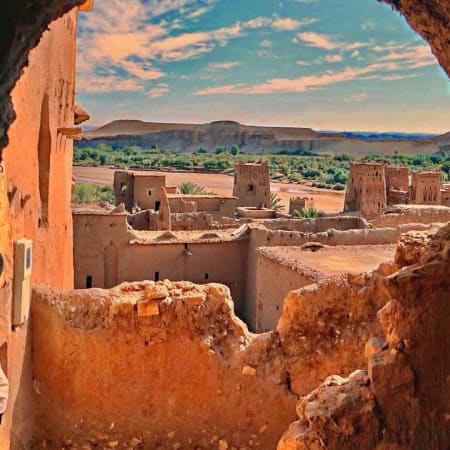
Travel along the Valley of a Thousand Kasbahs to Morocco's most famous kasbah, Aït Benhaddou. Pass through the Rose Valley and stop in Kelâat M'Gouna to admire the rose bushes bordering plots of farmland. Visit a rose collective to see the process of converting rose petals into rose water and oil. Continue west to stop in Ouarzazate and discover how its nearby regions have been featured in movies, including Game of Thrones, Lawrence of Arabia, Gladiator, and Black Hawk Down. Travel to nearby Aït Benhaddou. A UNESCO World Heritage Site, this old mud-brick ksar dates from the 11th century, when it held an important position along the trans-Saharan trade route. After lunch, leave Aït Benhaddou behind and begin the ascent over the High Atlas Mountains. Spot Mount Toubkal, the range's highest peak, at 13,671 feet (4,167 m). Near the top, stretch your legs for a fantastic panoramic view of the mountains. As you descend the High Atlas, you will notice a dramatic change in climate and landscape. Soon, you will be part of the noise and clamour of Marrakech.
-
10Day 10
Marrakech Medina Guided Tour
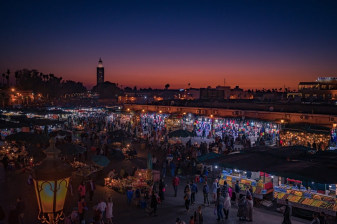
Nicknamed the "Red City" for its 1,000-year-old red sandstone city walls and buildings, Marrakech has always been a thriving city dating back to the Berber Empire (1062 ACE). Meet your guide for a half-day tour. Start by browsing the stalls of Souk el Attarin (spices), Souk Haddadine (blacksmiths), and Souk Smata (slippers). Then visit Souk des Teinturiers, the dyers' souk, and the Koutoubia Mosque. Along the way, note the open spaces extending off some alleys. These fondouks were once medieval inns that provided travellers and merchants with shelter for themselves and their animals. The hard-to-miss mosque's 253-foot (77 m) minaret is the tallest tower built in Marrakech. Relax in the adjoining gardens before continuing to Ben Youssef Madrasa. Built in the 16th century, this madrasa once housed students of the nearby mosque. Admire Moroccan artisanship in carved cedar, stucco plaster, and zellij tiling. Visit the Marrakech Museum or the Museum of Moroccan Arts for more examples of traditional art and woodwork. South of Jemaa el-Fna is the Kasbah area, which has several worthwhile sights, including the Saadian Tombs, El Badi Palace, Bahia Palace, and the Jewish Mellah and cemetery.
-
11Day 11
From Marrakech to Coastal Essaouira
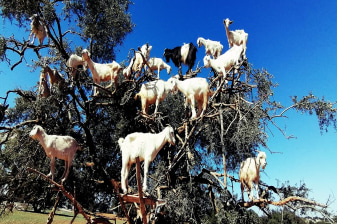
Say goodbye to the Red City and travel to Morocco's west coast, following a route that takes you over vast rolling plains. Along the way, pass through an argan tree forest, which is endemic to this part of the world. You may even see goats dining on the argan fruit up in the tree branches. Visit an argan cooperative to learn how argan oil is extracted from the tree and how it is used in the food and cosmetic industries. Arrive in the port city of laid-back Essaouira, a nice contrast to frenetic Marrakech, and spend the rest of the day as you choose. Walk the Skala de la Kasbah, the 18th-century seafront ramparts, along the coast. Designed by European engineers, old brass cannons line the walls and offer views over the Atlantic. Explore the UNESCO-protected medina before making your way to the windswept beach. Jimi Hendrix fans may want to take a short ride to Diabat at the end of Essaouira's beach, where he reportedly spent some time. Walk back to Essaouira and enjoy a meal of freshly caught seafood.
-
12Day 12
Essaouira to Casablanca via El Jadida
Around 8 am, you'll head north to the 15th-century Portuguese fortified city of Mazagan, now known as El Jadida and nicknamed "the Deauville of Morocco." Its Portuguese structures, fortified ramparts, and defensive system surrounding the medina, which is built out into the sea, all evoke the city's past history. Listed as a UNESCO World Heritage Site, this ancient coastal town is an impressive testimony to Portuguese architecture. Continue driving north to Casablanca, where you will spend your last night in Morocco before leaving.
-
13Day 13
Departure from Casablanca
Our trip ends today, and we say "See you again" instead of "Goodbye." We hope you spent one of your best and most unforgettable holidays with us.
Meeting Point
Meeting point: Tanger, Maroc · Tour start: Tanger, Maroc — Tour ends at the same location as the start point.